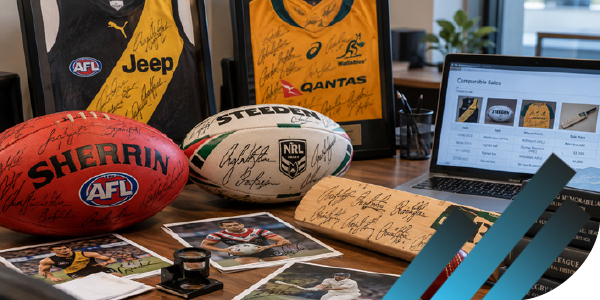
Valuing sporting memorabilia presents some interesting challenges for professional valuers because much of the value often sits in the story surrounding the object rather than the object itself. A football jumper, cricket bat, medal or photograph can move significantly in value depending on who used it, when, where and what evidence exists to support that history.
Establishing exactly what is being valued is therefore a critical starting point. A match-worn jersey, player-issued jersey, signed retail jersey and unsigned retail jersey are four different propositions. Descriptions used by owners, dealers and auction houses are not always consistent, so the valuer needs to establish what can actually be supported by the available evidence.
Provenance becomes particularly important where value depends upon an association with a player, team or event. Photographs, correspondence, previous auction records, club documentation, certificates and evidence of direct acquisition can all assist. The strength of that evidence should form part of the valuer’s assessment rather than simply accepting the provenance supplied by the client.
Authenticity can present another challenge, especially when collectors seek equipment that has a signature. Signed material, match-used equipment and higher-value memorabilia can attract sophisticated counterfeits and questionable attribution. Third-party authentication can be useful, but valuers should understand what has actually been authenticated, who provided the opinion and the standing of that provider in the relevant market. Where specialist authentication is required, obtaining that expertise may be an important part of the assignment.
Sporting significance can have a substantial effect on value. Equipment associated with a grand final, championship, record, debut, retirement or significant performance may occupy a very different market from otherwise comparable material. The task is to establish both the connection and whether market evidence demonstrates a premium for it.
Rarity should similarly be considered alongside demand. An item may be extremely scarce but have a limited collector market. Conversely, memorabilia relating to a highly collected player or team may attract strong competition even where comparable material appears relatively regularly. Understanding the depth and behaviour of the relevant collector market is therefore important.
Condition also needs to be considered in context. With some memorabilia, evidence of genuine use can contribute positively to its appeal. Wear on a match-used jersey or bat, for example, may form part of its provenance. Restoration, alterations, replaced components, fading or inappropriate cleaning can have a different effect. Condition should be assessed according to how participants in that particular market respond to it.
Selecting and analysing comparable sales is where professional judgement becomes particularly important. A superficially similar item may be a poor comparable if the player, event, provenance, condition or authentication is materially different. Completed arm’s-length transactions will generally provide stronger evidence than asking prices, dealer listings or unsold auction lots, although each can provide useful market context.
The Auctioneers and Valuers Association of Australia (AVAA) is actively promoting the importance of valuations prepared by an AVAA Certified Valuer (CVAu). These provides confidence that sporting memorabilia is being assessed by a qualified professional working to recognised professional standards. A certified valuer considers authenticity, provenance, condition, relevant market evidence and the valuation purpose, providing an independent, evidence-based opinion of value that can be clearly supported.
Timing can also matter. Sporting memorabilia markets can respond quickly to championships, records, retirements, anniversaries and renewed interest in particular players or teams. The valuer should therefore consider whether older sales remain representative of market conditions at the valuation date.
The basis and purpose of valuation must also remain clear. Market value, insurance replacement, taxation, estate administration and family law assignments can require different assumptions and approaches. Retail prices should not simply be adopted as market value.
For the professional valuer, the key questions are ultimately familiar ones: What exactly is the asset? What evidence supports its attribution and provenance? What characteristics are driving demand? Which transactions are genuinely comparable? And what does that evidence indicate about value at the valuation date?
Sporting memorabilia may be highly specialised, but the fundamentals remain the same: identify the asset properly, understand its market, test the evidence and clearly explain how the valuation conclusion was reached. To find out more, don’t miss the AVAA Valuing Sporting Memorabilia Webinar on 7 October 2026, so register online today.
.
.
Interested In Finding Out More?
If you’d like more information on the AVAA Valuing Sporting Memorabilia Webinar, send an email to cpd@avaa.com.au or telephone 1300 928 165. You can also stay up to date by following AVAA on LinkedIn, X/Twitter and Facebook.
.