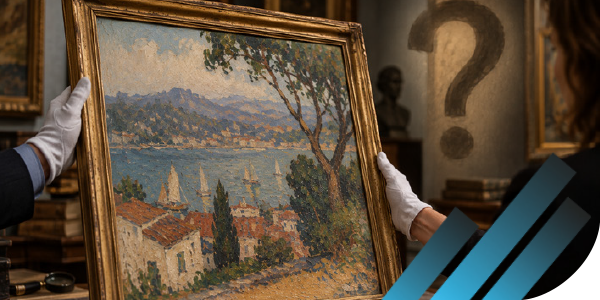
You have valued hundreds of artworks, examined countless auction results and developed a professional eye that comes from decades of experience. But what happens when the evidence supporting an artwork’s authenticity is convincing, while its provenance raises questions that could fundamentally change what a buyer is prepared to pay?
For certified valuers of fine art, the difficult cases are rarely those involving obvious forgeries or plainly incorrect attributions. The real challenges arise when an artwork appears genuine, the documentation seems credible and comparable sales provide a reasonable basis for valuation, yet one unresolved question has the potential to change everything.
Consider a painting attributed to a prominent artist, with a documented exhibition history and several comparable auction results. The artist’s work regularly achieves six-figure prices. However, the painting has a twenty-year gap in its ownership history, and the current owner has provided a certificate of authenticity issued by a gallery that ceased trading decades ago.
Would you value it at the level indicated by comparable sales? Apply a discount for uncertainty? Seek further specialist advice? Or conclude that the available evidence is insufficient to support a reliable market value?
More importantly, could you explain and defend that decision if another experienced valuer reached a substantially different conclusion? These are the situations where professional judgement becomes particularly important, and where even experienced valuers may approach the same evidence differently.
A catalogue raisonné might support an attribution, but what happens when the artist’s estate disputes it? An artwork may have appeared in several reputable auction catalogues, but does repeated publication establish authenticity, or simply perpetuate an earlier assumption?
Provenance itself raises questions and although an uninterrupted ownership history can strengthen market confidence, how should a certified valuer assess a work with incomplete documentation when there is otherwise compelling evidence of authenticity?
The Challenge For Certified Valuers
When two experienced valuers examine the same artwork, how much difference in their conclusions is reasonable? For AVAA Certified Valuers (CVAu), the challenge extends beyond selecting comparable sales. The key reference document is AVAA Professional Standard 6 – Minimum valuation report requirements that requires defensible reasoning and appropriate supporting evidence. Attribution uncertainty, disputed provenance and conflicting expert opinions test precisely how valuers substantiate their conclusions, explain limitations and distinguish market evidence from professional assumptions.
Perhaps one of the most interesting questions for a certified valuer concerns the relationship between authenticity and market value. A painting may be unquestionably genuine, yet buyers could remain reluctant because of unresolved ownership issues, disputed exhibition records or concerns about how it entered the market. Conversely, a work with an incomplete provenance might command a substantial price because knowledgeable collectors consider the attribution sufficiently convincing.
Should the certified valuer reflect the market’s willingness to accept uncertainty, even where that willingness appears inconsistent with the available evidence? The distinction becomes particularly important when preparing valuations for insurance, deceased estates, family law proceedings or financial reporting. The purpose of the valuation may influence the appropriate basis of value, the evidence required and the significance of unresolved questions.
Experienced valuers must also consider how far their investigations should extend. At what point is reliance on a recognised specialist reasonable? When should an attribution be qualified? And how should uncertainty be expressed in a valuation report without creating a misleading impression of precision?
With digitised archives, technical analysis and previously inaccessible historical records continuing to reveal new information, even longstanding assumptions about well-known artworks can warrant reconsideration.
The issue is not whether experienced valuers understand authenticity and provenance. It is whether the profession has a sufficiently consistent approach to interpreting uncertainty and translating it into defensible valuation conclusions. These questions will be explored during the Perspectives on Authenticity and Provenance sessions at the 2026 Australian Auctioneers and Valuers Symposia during October 2026.
This Year’s Meeting Of Valuation Opinion Leaders
You may have spent thirty years valuing fine art, but would another experienced valuer reach the same conclusion from your evidence? The 2026 Auctioneer and Valuers Symposia in late October 2006 provides an opportunity to explore how galleries, auction houses and valuation professionals approach disputed attribution, incomplete provenance and conflicting expert opinions. The value lies in examining differences in professional judgement that can materially influence valuation outcomes and client decisions.
The discussions at the 2026 Auctioneer and Valuers Symposia will bring perspectives from the gallery sector into conversations about attribution, ownership history, documentation, due diligence and market confidence. For experienced artwork valuers, this is an opportunity to test established approaches against the expectations and practices of those who acquire, exhibit and sell art. After all, the most interesting professional discussions are often those where knowledgeable people examine the same evidence and arrive at different conclusions.
Don’t miss the symposia that’s being held in Sydney on 21 October 2026, Melbourne on 20 October 2026 and Brisbane on 23 October 2026.
.
Interested In Finding Out More?
If you’d like more information on the 2026 Auctioneer and Valuers Symposia, send an email to cpd@avaa.com.au or telephone 1300 928 165. You can also stay up to date by following AVAA on LinkedIn, X/Twitter and Facebook.
.